
SOLUTIONS
Building Systems Network Assessment
The first step to creating order from the chaos
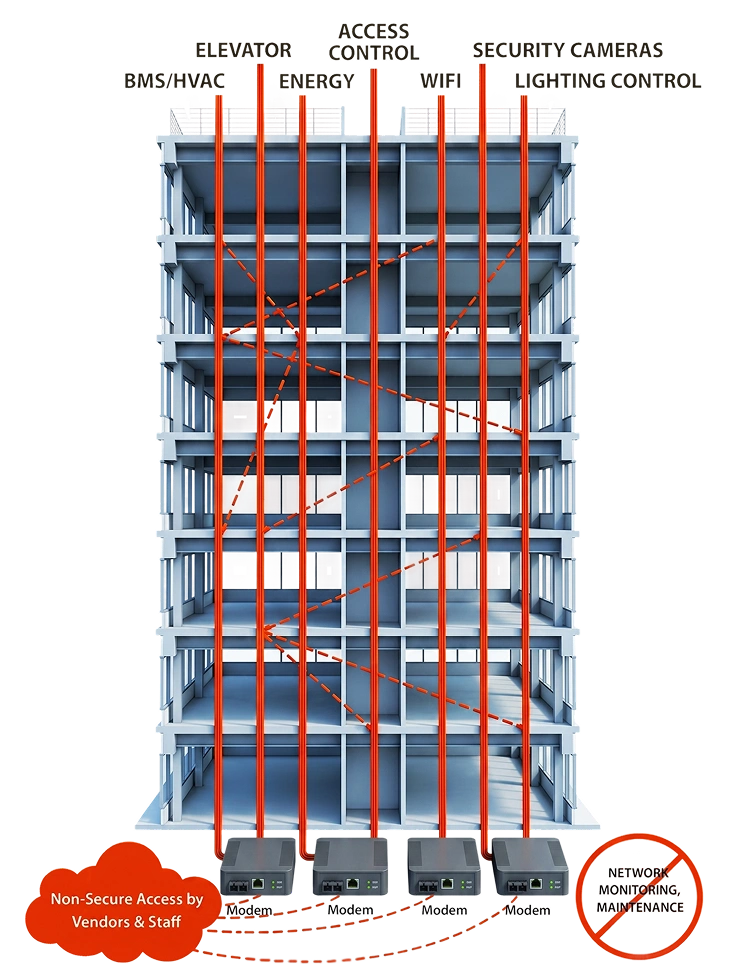
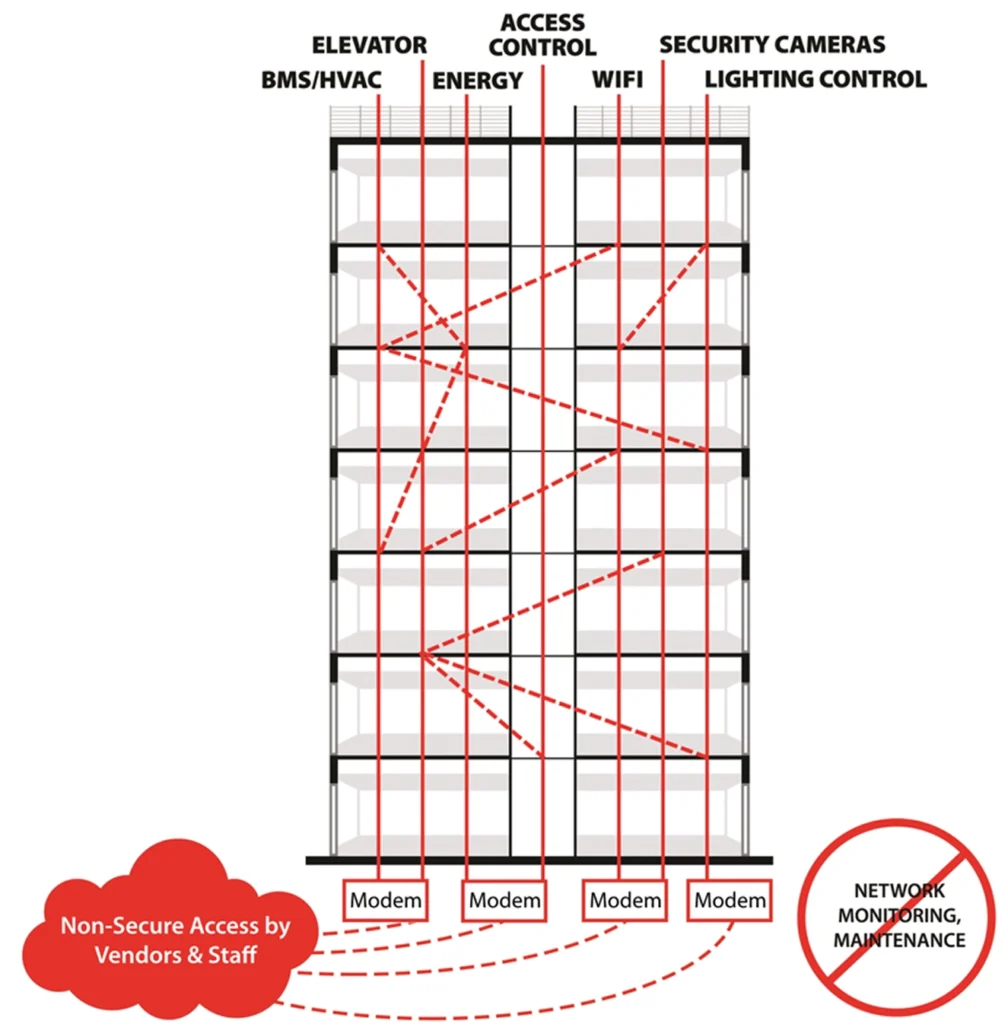
For decades, buildings have added technology haphazardly, creating a “spaghetti mess” of systems, cabling, and infrastructure. No one knows what equipment is connected, where it is located, or how it is connected.
For that reason, most buildings start with a Building Systems Network Assessment report. Our comprehensive report shows:
- What equipment and devices are in the buildings
- Where they are located
- How they are connected
- Which are cybersecure
- Physical infrastructure attributes
- Available opex savings (reduction of internet circuits)
Know Where You Stand
The findings are displayed by building system in an easy-to-read, green-yellow-red format:
- Satisfactory
- Action recommended
- Action required
A network assessment of the building systems provides the information you need to prioritize for what matters most, while providing flexibility to budget for lower priorities over time.
Building Systems Inventory
To show you we’ve done our homework, we also provide a complete inventory of all building system equipment, showing you what it is, where it is located, and how it is connected.
Item #1
How Do I Know If We Need An Assessment?
Answer: If you haven’t had one, you need it.
Most buildings have more systems than anyone realizes. Here is just a partial list:
- Access Control
- Air Quality Monitoring
- Audio Visual
- BAS/BMS
- DAS
- Digital Signage
- Elevators
- Energy Management
- Energy Monitoring
- Fitness Equipment
- Health Monitoring
- Irrigation Control
- Key Management
- Leak Detection
- Lighting Control
- Lobby Directory
- Occupancy Monitoring
- Parking Access Control
- Parking Charging Stations
- Parking Revenue Control
- Parking Security System
- Phone System
- Security System
- Seismic Detection
- Shade Control
- Solar
- Trash Compactor
- Visitor Management
- Water Treatment
- WiFi
Everyone is aware of certain systems installed in the building, like Access Control, Security, and WiFi. However, take a closer look at the list, and you’ll see systems that are less “top of mind” – like Digital Signage, Key Management, and Leak Detection. You’re only as secure as your weakest system – it only takes one that’s not secure to make the building vulnerable to cyberattacks.

Pricing
Because we’ve performed Building System Assessments for over 15 years, our pricing reflects our expertise and efficiency.
Every assessment is quoted on a transparent, fixed-price basis. All travel and other expenses are included – no change orders or extras of any kind, ever! Pricing is transparent and based on the building’s square footage. Discounts are provided for campuses and portfolios.
The Smart Building Foundation
Secure. Proven. Affordable.
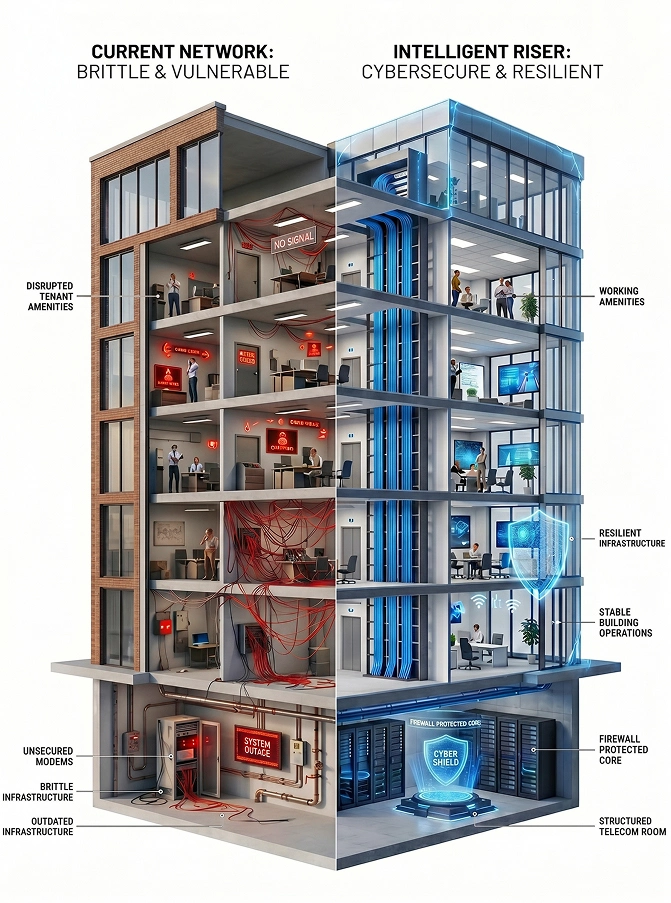
Building systems are vulnerable to cyberattacks because the networks that run the systems are a mess – old, nonsecure, and brittle, resulting in outages that affect building operations, data, and tenant amenities. Do you know of a building that has ever:
- been hacked?
- experienced crappy WiFi?
- had an unplanned outage?
- lost access to building data?
These issues, and many others, are solved with the Intelligent Riser network.
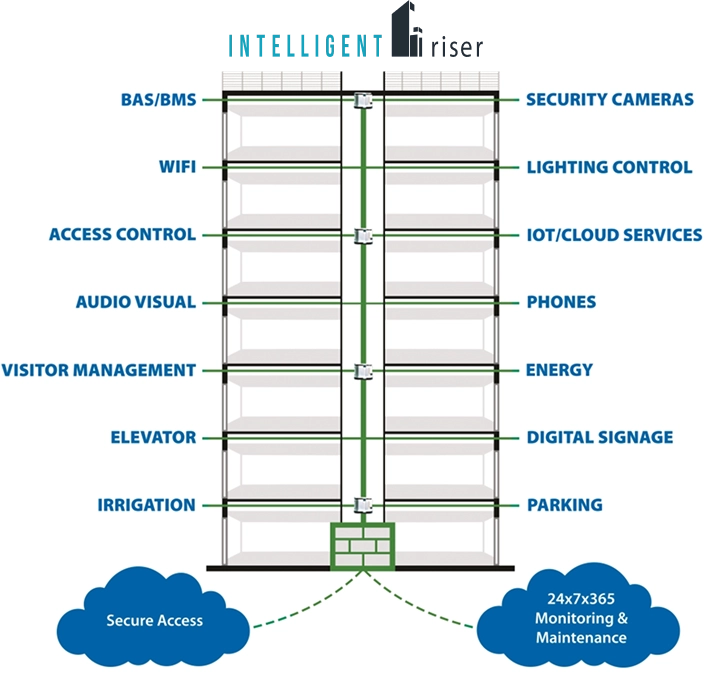
Intelligent Riser is a cybersecure, managed network designed to keep building systems secure, up, and running, 24x7x365.
Every Smart Building Starts with a Cybersecure Network
…and most buildings don’t have one.
In fact, most buildings don’t know what they have, which is why most look like the “Before” graphic below. Intelligent Riser puts buildings on the path to Smart by migrating all building systems onto a cybersecure, converged network that is monitored and maintained 24x7x365.
Wondering how to begin the process of going from “Before” to “After”? Start with an assessment to understand what you have, where it is located, and how it is connected.
Hardware is the Foundation for Software, Data, and AI
Smart Building solutions are only as effective as the network that connects them.
Without a robust building network, implementing software solutions is like constructing a building on a foundation of potato chips – too weak and too brittle, leading to suboptimal outcomes.
For a deeper dive, click here
In its simplest form, this is a building’s technology stack:
Layer 3 Applications
Utilizes data to create efficiencies
Layer 2: Data
Centralized and standardized for use with applications
Layer 1: Network
Foundational: ensures systems function and data gets where it needs to go